Read Time: 8 min
Last Update: 10 April 2026
Choosing between Level 2 and DC Fast Chargers depends on your site’s ‘dwell time’ and existing electrical capacity.
-
Level 2 (AC) Charging: Best for workplaces, hotels, and fleets where vehicles are parked for 4–8 hours. These are cost-effective, typically delivering 7kW–22kW, and avoid expensive grid upgrades.
-
DC Fast Charging: Essential for service stations or highway stops requiring 15–30 minute turnarounds. While offering high-speed convenience, units (25kW–350kW) often require significant electrical upgrades or a new transformer.
- The Bottom Line: For retail and hospitality, a 22kW–25kW ‘Goldilocks’ unit balances speed and initial costs, attracting ev owners without triggering massive operational costs through peak demand charges.
Want to know more about installation pricing?
Fast, licensed installs with upfront, no-surprise pricing.
Choosing between Level 2 and DC fast charging has nothing to do with which charger is 'better'; it’s about how long people are actually sticking around. Think of Level 2 as a slow top-up for long stays, while DC is more like a high-speed fuel pump for drivers who need to get back on the road.
Investing in a lightning-fast charger where cars stay parked for eight hours is just throwing money away. On the flip side, a slow charger at a roadside rest stop is basically a paperweight, and nobody is going to wait around for it. This guide skips the jargon to help you match your charging speed with your site’s 'dwell time' and your building's electrical capacity.
Commercial EV Charging: A 30-Second Summary
The real difference between the two comes down to where the power actually gets converted before it hits the battery.
⚡ Level 2 Business EV Chargers (AC)
This is your long-stay charger. It sends Alternating Current (AC) to the car, which the car then converts to DC to top up the battery. These are much easier on the wallet to install, but you're looking at a 4–8 hour window for a full charge.
⚡ High-Speed DC Fast Charging
This is your high-speed charger. It does the heavy lifting of converting power to Direct Current (DC) before it even reaches the plug, dumping that energy straight into the battery. You can get most EVs to 80% in as little as 20 minutes, but the trade-off is the need for some pretty serious heavy-duty electrical infrastructure.
Technical Breakdown: EV Charging Speed & Capacity
To compare these systems fairly, you have to look at the ‘throughput’: how much energy is moving and how much your building’s electrical panel can actually handle.
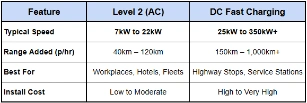
Single Phase vs. Three-Phase Power
Most Australian commercial sites already have three-phase power, which is a huge advantage; it means you can often jump straight to 22kW charging without a massive headache.
A Level 2 charger can take advantage of this to deliver 22kW (roughly 120km of range per hour). If you only have single-phase power, you'll be capped at 7.2kW.
Fast chargers need massive amounts of current. Even a "small" 25kW DC unit pulls more power than most large office air-conditioning systems. If you're looking at 50kW or 150kW stations, you aren't just looking at a new circuit; you're likely looking at a new sub-board and a conversation with your network service provider (like Ausgrid or Energex).
🔌 The Australian Standard Plug for EV Chargers
The Australian market has basically settled on the Type 2 plug for Level 2 and CCS2 for DC. Unless you're dealing with a few specific older models, those are the only two 'nozzles' you really need to worry about.
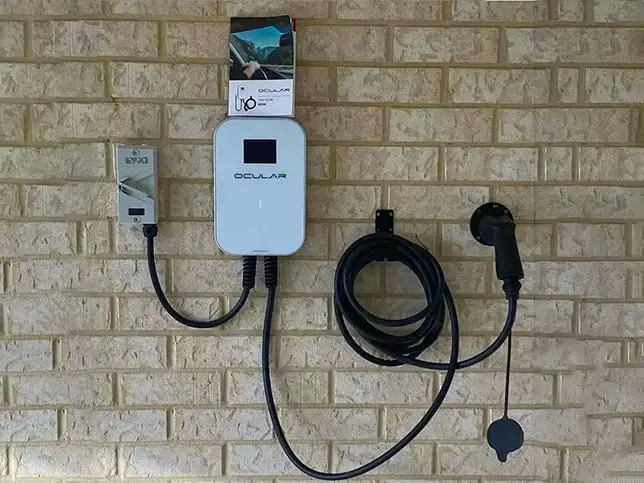
Level 2: These are often 'universal' (untethered) sockets, meaning drivers bring their own cable to plug in. This is great for durability because there’s no cable to get run over or vandalised, but it does mean your users need to have a Type 2 to Type 2 lead in their boot.
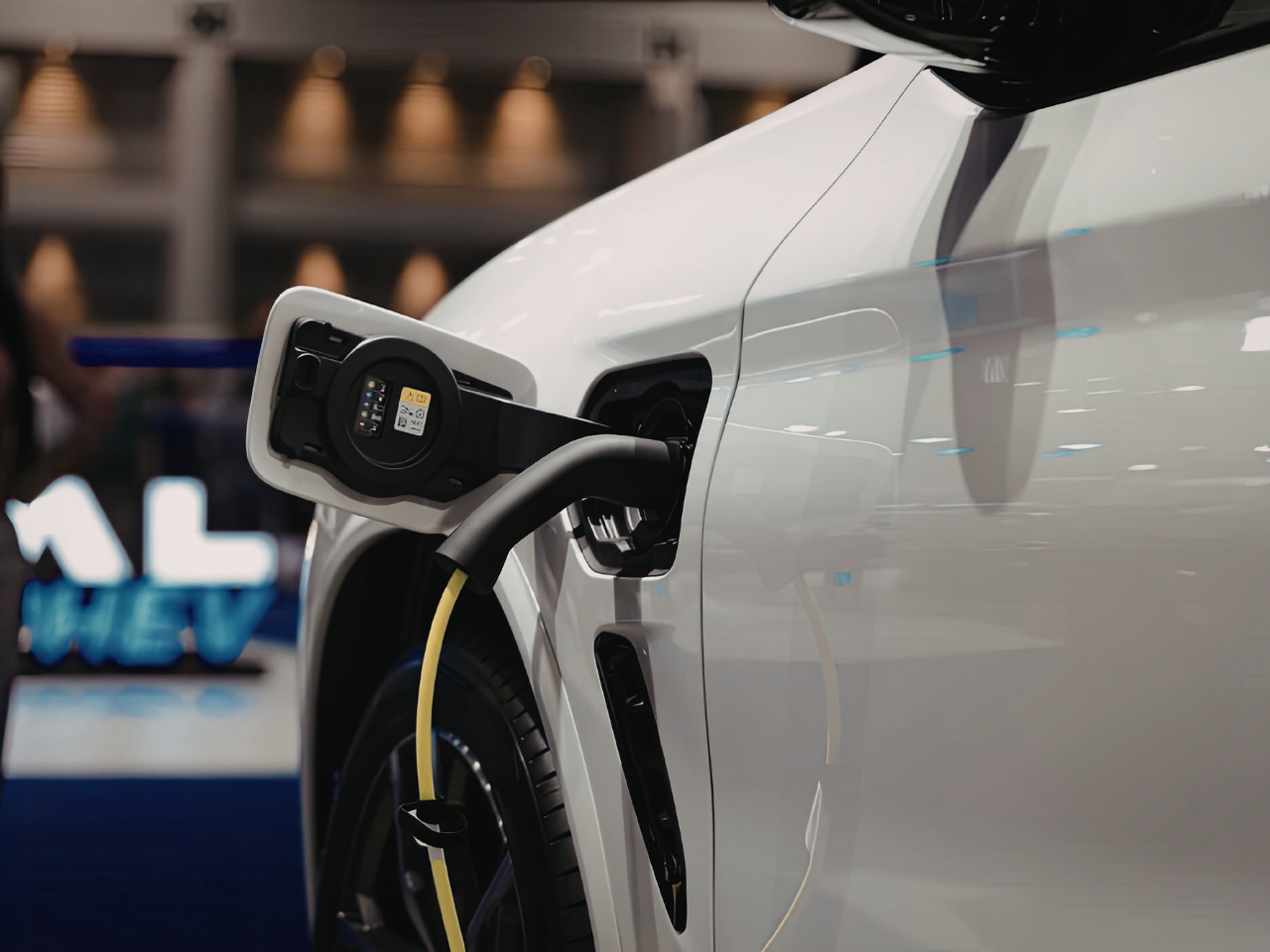
DC Fast Chargers: These are always tethered. Because the cables have to handle an immense amount of current—and are often liquid-cooled to keep from melting—they’re permanently attached to the unit. You won't need to supply your own lead here; just pull up and plug in.
The CHAdeMO Exception: While CCS2 has pretty much won the battle in Australia, you’ll still see the occasional older Japanese EV (like an early Nissan Leaf) that needs a CHAdeMO plug. Most public sites use dual-head chargers to cover all bases, but if you’re setting up a private fleet, you’re almost certainly safe just sticking with CCS2.
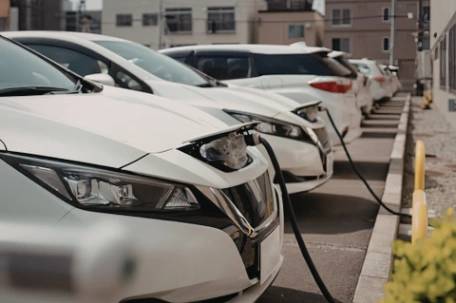
Infrastructure & Grid Impact for Commercial EV
In Australia, the gap between a ‘quick install’ and a ‘major infrastructure project’ comes down to how much spare capacity is in your switchboard.
↔️ The Power Gap
Level 2: These run on standard 240V or 400V power. Most commercial sites can add a few of these without a major headache—it’s roughly the same load as adding another large air-con unit.
DC Fast Charging: These are industrial-grade power hogs. A single 150kW station can draw as much power as an entire small office block. If your site doesn’t have the headroom, you’re looking at a new sub-board, upgraded mains, or even a dedicated kiosk transformer from your network provider (like Ausgrid or Energex).
💲 Watch Out for Peak Demand Charges
Most Australian commercial power bills include a Peak Demandfee. If a car pulls 50kW from your charger during your building's busiest hour, your electricity bill for the entire month could skyrocket based on that one 20 minute spike.
✨ The Fix: Smart EV Charging Load Management
This is essentially a "brain" for your chargers that lets them "talk" to the rest of the building. If the office aircon and lifts are working overtime, the chargers automatically throttle back to stay under your site's limit. Once the building goes quiet, or your solar kicks in, the chargers ramp back up to full speed, saving you from those nasty ‘peak demand’ surprises.
Matching the Charger to the ‘Dwell Time’
Installing a charger that’s faster than your ‘dwell time’ (how long a car actually sits in your park) is just wasting money. To get the best return on investment, you need to choose the hardware that matches your users' natural habits.
🏨 Workplaces & Hotels (8+ Hours)
Employees and guests are there for the long haul. A 7.2kW or 22kW (Level 2) unit is the winner here—it’s cost-effective to install, and the car will be fully charged by the time they leave.
🏪 Retail, Gyms & Cafes (1–2 Hours)
Customers want a meaningful top-up while they shop. A 22kW AC unit or a 25kW Destination DC charger is the sweet spot. It provides enough range to be a drawcard without requiring a massive grid upgrade.
🛣️ Service Stations & Highway Stops (15–30 Mins)
Drivers are on the move and in a hurry. This is the only place where the big 150kW+ DC fast chargers are essential.
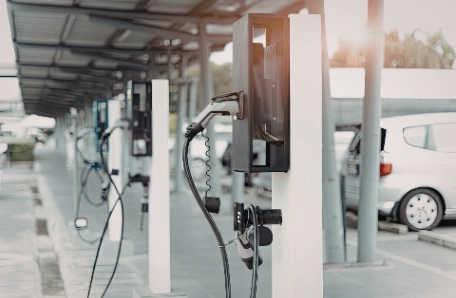
The Cost-to-Benefit Ratio for Business EV
At the end of the day, an EV charger isn't just a piece of electrical gear; it’s a business investment. To get the best bang for your buck, you have to look past the sticker price.
☝ The Slow Advantage
Level 2 AC chargers are significantly cheaper to buy and install. If your staff or guests are parked for hours, a $2,500 unit does the exact same job for your business as a $50,000 fast charger, but without the massive infrastructure bill.
☝ Future-Proofing vs Over-Engineering
It’s tempting to go for the biggest, fastest unit available, but if it forces you to spend $100k on a new kiosk transformer you don't actually need, your ROI will take years to recover.
☝ Attraction vs Expense
For retail and hospitality, the goal is ‘drawcard’ value. A mid-range 22kW or 25kW charger is often the Goldilocks zone: fast enough to attract high-spending EV drivers but small enough to fit into your existing electrical headroom.
The bottom line: The most profitable charger is the one that stays busy without blowing out your monthly power bill.
Future-Proofing & Scalability of EV Charging
The biggest mistake isn't starting small; it’s starting in a way that makes expansion impossible. You don't need 50 chargers today, but you do need to make sure you aren't paying to rip up the same bitumen twice.
1️⃣ The ‘Pipe is Cheap’ Rule
If you’re digging a trench for two chargers, lay the conduit (the plastic piping) for ten. The pipe itself costs pennies; the excavators and labour cost thousands. Even if those pipes sit empty for now, you’ve essentially "pre-paid" for your future expansion at a 90% discount.
2️⃣ Avoid ‘Vendor Lock-in’
Only buy chargers that are OCPP-compliant.
The Risk: Some brands lock their hardware to their own software.
The Fix: OCPP is the industry standard. It ensures that if your software provider hikes their prices or goes bust, you can switch to a new provider without binning your expensive hardware.
3️⃣ Think Modular
Don't blow the budget on one massive unit that sits idle. Start with a system that allows you to add satellite dispensers as demand grows. This keeps your upfront costs low while ensuring you won't hit a brick wall in three years.
Summary: Matching Fast Chargers and AC Types to Business Revenue Goals
Getting your ev charger installation right means matching the tech to your site's dwell time. While rapid charging (DC) offers high-speed convenience for ev users, that extra voltage often triggers expensive electrical upgrades. For most ev owners, slow charging is the smarter way to keep initial costs and operational costs low without losing efficiency.
Whether you’re scaling your ev infrastructure or just starting with a small number of evs, we help you pick the right charger from the best options for electric vehicles in Sydney.
Call our friendly EV Charger Installation team for more information on 02 9100 0782 or complete our enquiry form today.
Published by: 10 April 2026