Read Time: 7 min
Last Update: 2 March 2026
Most Sydney commercial and strata buildings require a switchboard assessment before installing EV chargers. While some modern boards can handle a single charger, a fleet of EVs plugging in at 5:00 PM creates a "Sync-Charge"—a massive power draw that can redline your main board and trip the building's power. Whether you need a full upgrade depends on your building's age, its current spare capacity, and whether you use smart load management to "balance" the draw.
Want to know more about installation pricing?
Fast, licensed installs with upfront, no-surprise pricing.
Buying an EV is the easy part; realising your outdated switchboard might actually melt trying to charge it is the real wake up call.
Your main switchboard is the brain of your home, but most were only built for a fridge, some lights, and a TV. They weren't designed for a dedicated charger that pulls as much juice as three air cons running flat out at the same time.
If you’re wondering whether you can just ‘plug and play’ or if you're about to blow a fuse the second you hit the power, here is the honest truth from an electrical expert about when you need a switchboard upgrade.
Electrical Load: Why EV Charging is Different to Other Appliances
You might think, "I run a dryer and a kettle at the same time, so what’s the difference?" It comes down to stamina.
Most appliances are ‘sprinters’. A kettle boils in two minutes and shuts off. An oven cycles on and off. Your wiring gets a rest between these bursts of electricity.
An EV charger is a marathon runner. EV charging pulls a massive, steady stream of electricity, a full 32 amps, for 8 to 10 hours straight. There is no ‘cycling off’. It’s running flat out all night.
The catch: If your switchboard has any weak points, that 8-hour marathon of heat will find it. This is how you end up with hot spots, melted plastic, and fire risks.
Your old switchboard was built for a 100-metre sprint; an upgrade makes sure it can handle the load requirements without breaking a sweat.
The 3 Signs You Definitely Need an Upgrade
1️⃣ You Still Have Old Ceramic Fuses
If you open your switchboard and see those white, porcelain blocks that you have to pull out and wrap with fuse wire when they blow: stop right there.
These are electrical hazards for electric vehicles. They don't have the smarts to handle a continuous 8-hour heavy load, and they offer zero protection against electric shocks. To legally install a home charger, these must be replaced with modern circuit breakers.
2️⃣ No Room for an EV Charger Circuit
A home EV charger requires its owndedicated circuit. That means we need physical space in your switchboard to click in a new safety switch.
If your board is already packed tight with no ‘spare ways’ (the empty gaps), we can’t just squeeze it in. Splicing into an existing circuit is a major violation of electrical safety standards and a recipe for a blackout.
3️⃣ No Modern Safety Switches (RCDs)
Look for a button that says ‘Test'. If you only have outdated switchboard components with no test buttons, you don't have RCD protection.
Australian standards are very strict: any new EV circuit must have its own safety switchto protect you from electrocution. If the board is too old to house these modern switches, the whole thing needs a refresh.
What is a Main Switch Capacity & Electrical Load Requirements?
Think of your main switchboard as the gatekeeper for your home’s total power budget. In a lot of older homes, that budget is only about 40 Amps. An EV is a massive spender—it wants 32 Amps all to itself. If you try to charge while the oven is on, you’ll overspend your budget, and the whole house goes pitch black.
The reality for your home:
- 7.2kW Charger: Requires an ev charger circuit and usually a 63A+ main switch.
- 40A Service: You’re going to need more power. We’ll need an electrical assessment to see if your electrical system can actually support the car and the house at the same time.
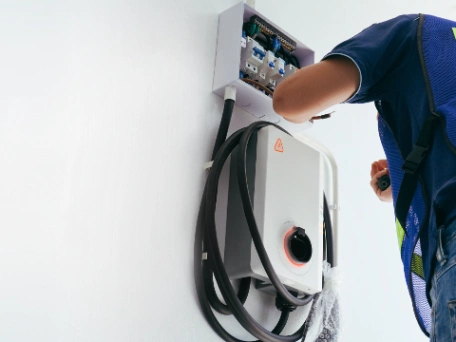
Three Levels of EV Charger Installation Upgrades
Level 1: Sub-Board Add On
If your main board is modern but physically full, we don't necessarily have to replace the whole thing. We can often mount a small sub-board right next to it. This holds the new EV circuit and safety switch without messing with the rest of your house.
🎯 Best for: Newer homes that are in good shape but just need one more "slot" for the new circuit.
Level 2: Full Switchboard Upgrade
This is the standard job for most 80s and 90s homes. We rip out the old ceramic fuses or those clunky old breakers and swap them for modern circuit breakers and surge protection. It brings the whole house up to current Australian standards, making it safer for your family, not just the car.
🎯 Best for: Homes still using old school fuses or lacking modern safety switches (RCDs).
Level 3: Three-Phase Power & Main Load Upgrade
If you want the absolute fastest charging possible (22kW) or you're planning on a two-EV household, a standard phase charger setup won't cut it. This involves a licensed electrician getting more power from the street. It’s a larger upfront cost, but it means you can charge at triple the speed (depending on your car) and never worry about the toaster tripping the car again.
🎯 Best for: Large families, dual EVs, or anyone who hates waiting for a charge.
The Hidden NSW Requirements for Licensed Electricians
In NSW, installing an EV charger isn't just a handyman job, it’s regulated work. To keep your home insurance valid and your warranty intact, there are two non-negotiables:
- Digital Proof: Your electrician must lodge a CCEW via the BCNSW eCert portal.
- Type B RCDs: Modern electric vehicles need specific current devices (Type A or B) to handle the specific power they pull.
💥 The Bottom Line: If a sparky offers to do the job without a compliance certificate, walk away. It’s not worth the risk to your house or your car's battery.
What Happens if I Don't Get an Electrical Upgrade?
Look, skipping an upgrade you actually need isn't just a risk. It’s a fast way to waste a lot of money. If you try to force a modern charger through a vintage board, things get ugly pretty quick.
Here’s what usually happens:
⚠️ The Midnight Blackout
You’ll be dead to the world when the car, the AC, and the fridge collectively 'overspend' your power budget. The main switch trips, and you wake up to a pitch-black house and a car that didn't charge a single percent.
⚠️ The "Slow Melt"
Old connections aren't built for 8-hour marathons. Continuous heat can melt wire insulation and plastic casings. If you start smelling "hot electronics" in the garage, it’s already too late.
⚠️ Insurance & Warranty Drama
If a fire starts at a non-compliant board, your insurer has a perfect excuse to walk away. Likewise, many EV brands require proof of a certified install to keep your battery warranty valid
⚠️ The Compliance Trap
As of July 2026, everything is digital. If your sparky doesn't lodge your job through the BCNSW eCert portal, it’s like the work never happened. No digital record means no insurance coverage if that "vintage" board decides to give up the ghost.
💥 The Bottom Line: Cutting corners now usually ends up costing you five times more in repairs and voided warranties than just doing it right the first time.
Cost Expectations
2026 Sydney Price Guide for an EV Charger (Ballpark Only)
Level 1 ($800–$1,200)
This now reflects the higher cost of Type B RCDs, which have become the industry gold standard for EV circuits.
Level 2 ($2,500–$4,500)
This includes the mandatory BCNSW eCertlodgement fee and the time it takes the sparky to digitise the whole home’s compliance record.
Level 3 ($5,000–$10,000+)
This is the most variable because of Ausgrid/Endeavour Energy fees. A simple overhead connection is at the lower end, while an underground street-to-house trench can easily push past $10k.
💥 The easiest way forward: Every house is a bit different, but a quick photo of your board is usually all we need to give you a firm price. No guesswork, no surprises.
Don’t guess. Get a firm price in minutes.
Trying to figure out your own electrical load from the couch is a headache you don't need. The fastest way to get your home ready for safe charging is to let an electrical expert take a look.
Send us a snap of your board today. A quick photo is usually all we need to tell you exactly which switchboard upgrade you need, if any. We’ll give you a "no-surprises" quote that covers all Australian Standards and NSW key requirements, so you can get back to enjoying your new car.
If you have any further questions or would like to book a home electrical assessment for an ev charger, call our friendly team today on 1800 870 538.
Resources:
SolarQuotes - EV Charger Installation: What's Involved
RACV - Installing an Electric Car Home Charger: What You Need to Know
Electric Vehicle Councile - EVSE Installation Guideline
Energy NSW - Switchboard Upgrade