Read Time: 8 min
Last Update: 16 March 2026
The right EV charger really comes down to how much you drive and what your home’s power can handle. You’ve basically got three choices: the slow 'granny cable' (Level 1), a dedicated home wallbox (Level 2), or high powered DC fast charging for commercial sites. Getting the levels right is the difference between waking up to a full battery or being stuck waiting for a slow trickle when you’re already late for work.
Want to know more about installation pricing?
Fast, licensed installs with upfront, no-surprise pricing.
Picking the right EV charger in Sydney usually comes down to one thing: how much range you need by morning. While every charger eventually fills the battery, the hardware and speed vary wildly between a standard wall plug and a dedicated home unit.
To help you choose the right setup, here is how Level 1, Level 2, and DC Fast charging actually compare
Level 1 Charging: The Standard Household Plug
Level 1 charging is exactly what it sounds like: plugging your car into a regular 10-amp wall socket. Most EVs come with a portable ‘trickle’ cable for this, meaning you don't need an electrician to get started.
The trade-off is the speed. Because a standard Sydney power point isn't designed for high-speed energy transfer, you’ll only see about 10km to 15km of range added per hour. For a driver doing 30km a day, an overnight plug-in is fine, but if you’ve had a long day on the M4 or the Spit, it could take over 24 hours to get back to a full battery. It’s best viewed as a backup or a slow-and-steady option for low-km drivers.
Level 2: The Fast Home & Commercial Standard Solution
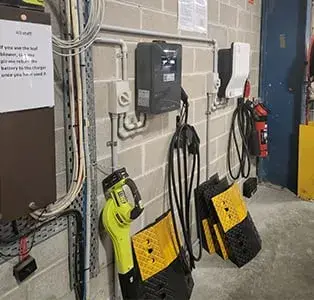
Level 2 charging is the sweet spot for most homes and workplaces. Unlike a wall plug, these units (often called wallboxes) are hardwired on their own circuit, pushing between 7kW and 22kW of power. In real-world terms, you’re looking at adding roughly 40km to 100km of range for every hour it’s plugged in.
For most drivers, this is a ‘set and forget’ setup; you plug in at night and wake up to a 100% full battery. Just keep in mind that while a 22kW charger sounds better, most EVs in Australia are actually capped at 7kW or 11kW.
Unless you have three-phase power and a car that can handle it, a standard 7kW install is usually more than enough to get the job done.
DC Fast Charging (Level 3): Rapid Public Charging
Level 3 is the heavy-hitter of the charging world. You won’t see these in a residential garage; they’re the massive units you find at highway servo or commercial hubs. Unlike home units that provide AC power, these stations pump high voltage DC power directly into your battery, bypassing the car's onboard limits.
This is how you get those super-fast results, potentially adding 300km of range in under an hour. They are perfect for a dash to the coast or the hinterland, but they’re not built for daily home use. The equipment is incredibly expensive, and the power draw is usually more than a standard residential street’s transformer could handle for one house. For most owners, Level 2 is your daily fuel station, and Level 3 is your highway stop for when you're on the move.
Apartment & Strata Charging Solutions
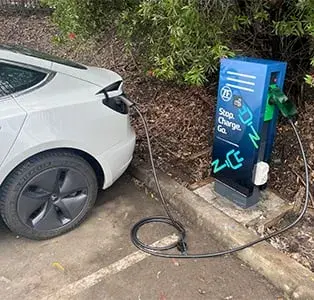
Installing EV charging in a Sydney apartment is a lot trickier than in a house. You aren't just dealing with your own garage; you’re navigating shared building power and NSW strata laws that have changed a lot recently.
Since July 2025, it’s actually become much harder for a committee to block your request on aesthetic grounds, and you now only need a simple majority vote (over 50%) to get a sustainability project across the line.
The key is to avoid doing this ‘one car at a time’. If everyone installs their own separate cabling, the garage quickly becomes a mess and you’ll eventually trip the building's main power.
A successful setup focuses on a coordinated building-wide strategy; getting the backbone wiring and a load management system in place first so that every resident can eventually plug in without the drama.
The Three Pillars of Strata Charging
📊 Load Management: Most Sydney basements weren't wired to have 50 cars charging at once. We use smart Load Management (LMS) to act as the building's brain, monitoring live power draw so your car gets a fast charge when there's room, but throttles back when the rest of the building is cooking dinner. It’s the only way to avoid a $50k+ grid upgrade just to keep the main fuse from blowing.
💲 ‘User Pays’ Billing: No one wants to subsidise their neighbour's commute. We set up transparent billing systems, often using RFID tags or smart apps, that track exactly how much electricity each resident uses, so the costs are charged back to the individual, not the common property fund.
🔌 The Backbone Approach: Instead of every resident running their own separate (and messy) cabling from the main switchboard, we recommend a shared ‘backbone’ tray through the basement. By installing the core distribution boards and cable runs now, future installs become a simple plug and play job for individual owners. It stops the basement from becoming a spiderweb of conduits and saves the building from having to redo the same electrical work fifty times over.
Solar Compatible EV Charging
If you have solar panels, your EV is basically a giant battery on wheels. Instead of sending your excess power back to the grid for a 6c feed-in tariff, or worse, getting hit with the new ‘Sun Tax’ for exporting during the day, you can use a smart charger to soak that energy into your car for free.
We use Solar Diversion tech to monitor your rooftop in real-time. If the sun is out, the charger automatically ramps up; if a cloud passes over or you turn on the kettle, it throttles back to make sure you aren't pulling expensive power from the grid. It’s the smartest way to get a $0 fuel bill and finally get a real return from your solar investment.
Comparison Table: Charging Speeds at a Glance

The Install Process: Why Professional Installation Matters
You can't just wing it with a DIY install. In Australia, putting in an EV charger is a regulated electrical task that legally requires a licensed electrician. It’s not just about the law, though; a charger pulls a massive, continuous load for hours on end. If the wiring isn't sized correctly or the switchboard isn't up to the task, you’re looking at more than just a tripped breaker; you're looking at melted components and fire risks!
A professional electrician makes sure your home stays safe, provides the CCEW (Certificate of Compliance) for your insurance, and makes sure your car’s warranty stays intact.
The Compliance Factor: AS/NZS 3000
In Australia, we follow the AS 3000 (often just called the 'Wiring Rules'). One of the biggest requirements is that your charger must be on its own dedicated circuit. You can't just piggyback off your aircon or pool pump wiring.
Think of it like a dedicated fast-lane for electricity. If you tried to share that power with other high-draw appliances, you’d trip the main breaker the second you started cooking dinner while the car was charging. A professional install ensures the car has its own direct line back to the switchboard, keeping your home’s power stable and safe.
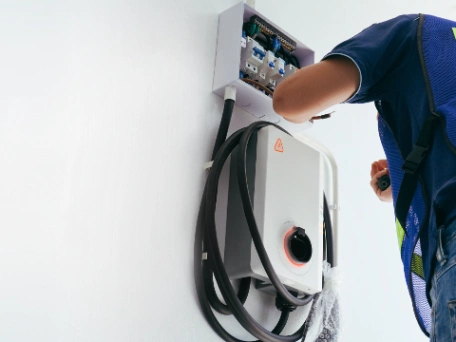
Key Steps in a Professional EV Charger Installation
1️⃣ Switchboard Check
Before we touch any wiring, we have to see if your switchboard can actually handle the heat. A Level 2 charger pulls about as much power as three large air conditioners running at once! If you’re in an older home with those classic ceramic fuses or an crowded switchboard, you’re going to need an upgrade. It’s not just about compliance; it’s about making sure your main switch doesn't melt under the 32-amp pressure of an eight-hour charge.
2️⃣ Safety Switches (RCDs)
A regular safety switch is designed for AC power (like your toaster). But an EV battery is a massive DC source, and if there’s a fault, it can ‘blind’ a standard switch, meaning it won't trip when it should.
We use Type A or Type B RCDs because they are built to see those specific DC faults. Think of it as a high tech guard dog for your switchboard; if even a tiny bit of current goes where it shouldn't, the power cuts instantly to protect your car’s sensitive electronics and your home.
3️⃣ The Certificate of Compliance (CCEW)
Once the job is done, your electrician has seven days to get you your Certificate of Compliance (CCEW). This isn't just extra paperwork; it’s your legal proof that the install actually meets the Australian Wiring Rules.
These days, it’s all moving digital. By July 1, 2026, paper forms won't even be accepted by the regulator. Your certificate should hit your inbox via the BCNSW eCert portal as soon as the sparky hits 'submit'.
Protecting Your Investment
It’s not just about the law, it’s about your investment. Brands like Tesla, Zappi, and Wallbox are strict: if you can't show a Certificate of Compliance (CCEW) from a licensed electrician, your warranty is essentially paperweight.
If a charger fails because of a ‘hot joint’ or a loose terminal (common issues with DIY or rushed installs) the manufacturer can easily spot the poor workmanship and deny your claim. A professional install ensures the cable is sized correctly so it doesn't run hot, meaning your charger lasts a decade rather than burning out in its first summer.
The Bottom Line: Don’t Just Install an EV Charger, Future-Proof Your Home
Electric vehicle charging in 2026 is about more than just a plug in the wall; it’s about managing your home’s biggest electrical load safely and efficiently.
Ready to get your Sydney property EV-ready? Call our friendly team on 02 9100 0782 or complete our enquiry form today to get your building on board.
Published by: 16 March 2026